VOL. 1 · JULY 2026
AI Agent Copilots:
How Asia Puts Them to Work
The question isn’t whether founders use AI.
It’s where AI sits in the flow of execution.
Execution Intelligence for Asia’s Act-preneurs
Hello, and welcome.
This is Action Brief : ASIA, the insight brief from the Underdogs Data Center.
This month’s question is a practical one: where does an AI copilot actually fit into a founder’s execution?
On the ground, venture-building is being judged by what founders ship rather than by what they know. AI has moved from the margins of entrepreneurship education into the work itself. The practical question is where it goes: task design, execution, feedback, and tracking the points where a founder’s momentum tends to break.
This edition of Action Brief : ASIA looks at Korea, Japan, Indonesia, and India to see how the AI copilot is changing founders’ execution speed and sustainable growth.
Today’s Action Brief, in three lines
1. Venture-building is shifting from learning to doing.
■AI copilots are being used less as teaching aids and more as working partners.
2. Four Asian markets each run the AI copilot in a different way.
■Korea for speed, Japan for removing friction, Indonesia for a chain of collaboration, India for widening access.
3. What separates founders is not knowing AI, but keeping execution from stalling with it.
■The measure is how much actually gets done on the ground with an AI copilot.
1. Opening Brief
From learning about AI
to executing with it
Venture-building has largely run on knowledge transfer and mentoring.
With AI copilots, founders get through idea shaping, market research, experiment design, and feedback more quickly. The shift is less about using AI heavily than about placing it where execution tends to stall.
When AI is connected across task design, execution, feedback, and tracking, the next action comes sooner.
This Action Brief looks at Korea, Japan, Indonesia, and India to see how the AI copilot is reshaping the way venture-building operates.
2. Korea Signal
Korea: cutting the time
it takes to finish
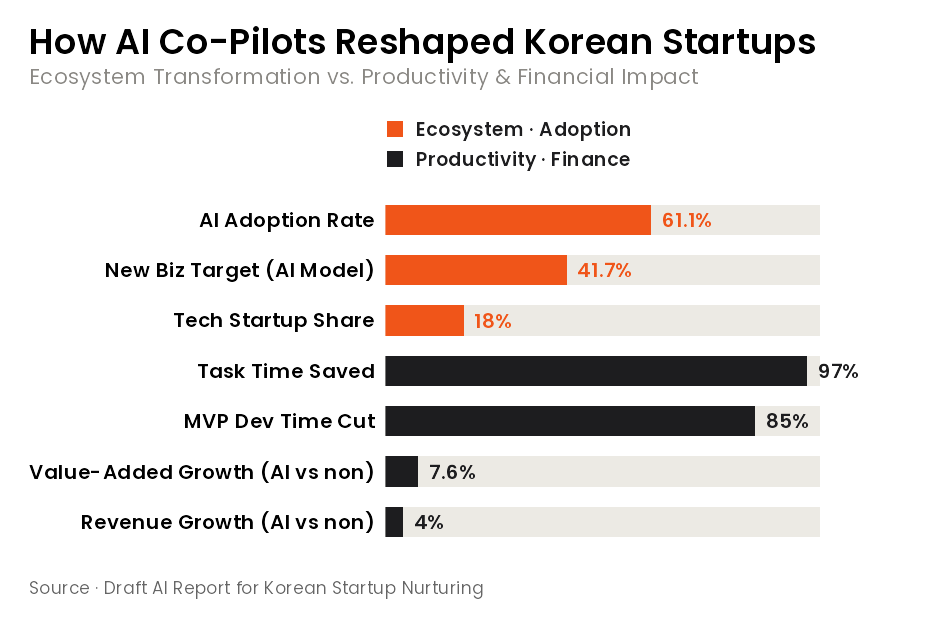
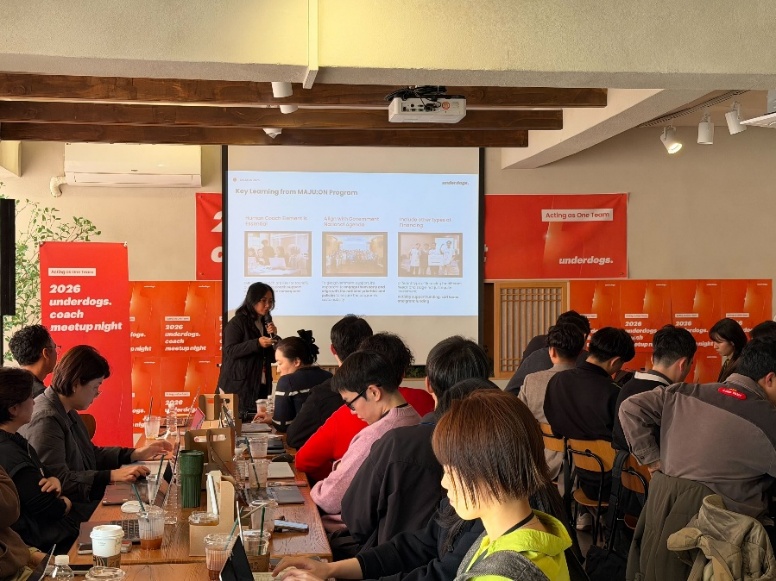
Korea’s startup ecosystem is using AI mainly to shorten execution time.
UD Impact’s Edu-Bot, ACT-Bot, and AI Co-founder support idea shaping, MVP development, and feedback, helping founders reach the next step sooner.
The first change is time.
As the time once spent on idea shaping and product development shrinks, founders can experiment in shorter cycles and read customer response sooner.
A second change is how teams are organized.
With AI, a team of one to three can plan, build, and validate without a large headcount. The Korean model is not only about efficiency: AI and data-based tracking are used to watch a founder’s execution flow, catch early signs of a slump, and help more founders finish what they started.
Korea Point
■ In Korea, the copilot is used above all to cut execution time.
■ Idea shaping and MVP development run in shorter cycles.
■ A one-to-three-person team can cover work that used to need more people.
■ Data-based tracking helps spot a slump early and keep execution going.
3. Japan Signal
Japan: getting past
the hesitation before starting
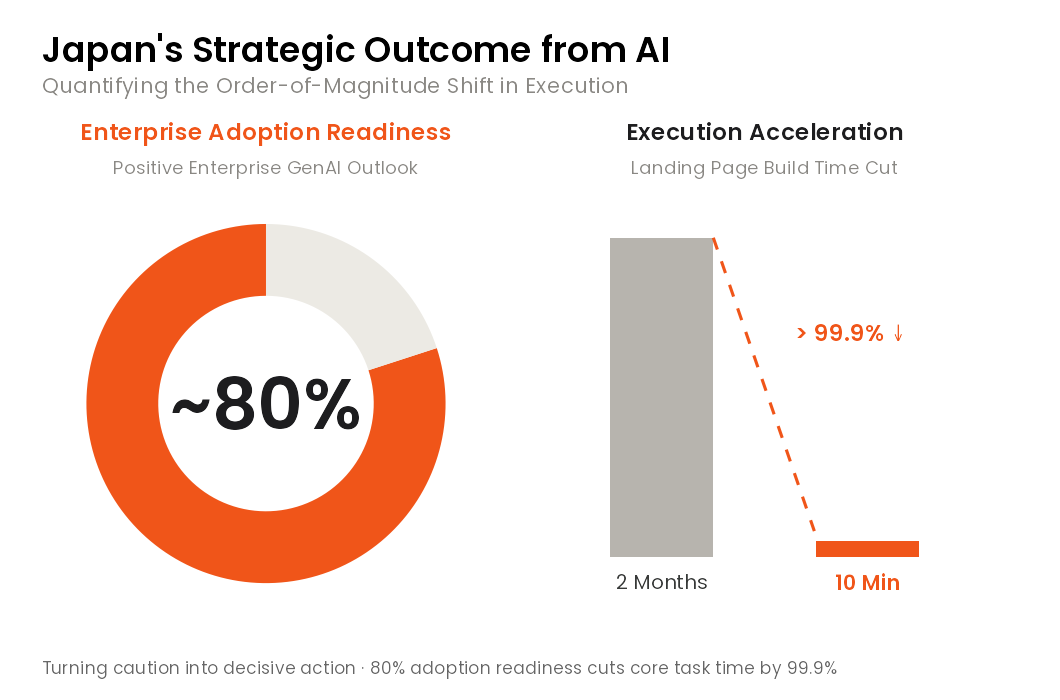
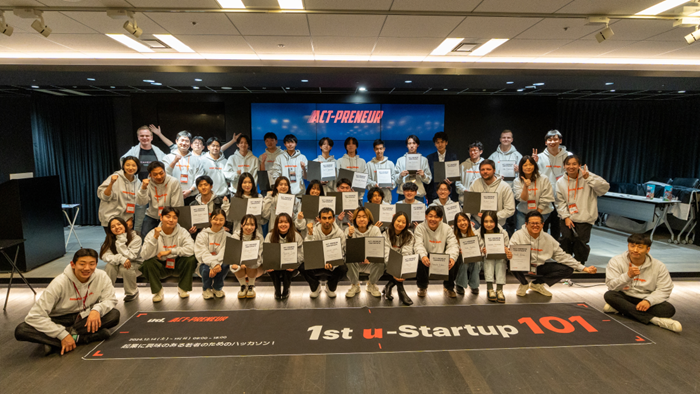
In Japan, the copilot is used to keep founders from stalling before they start. It takes the slow, heavy steps — market research, coaching, landing-page production — and cuts them down.
At Musashino University, AI deep research sharply cut market-research time. At Kobe Social Port and on the UDI LMS, AI drafted first versions and prepared coaching, easing the bottleneck that perfectionism and self-editing create.
In Kyoto’s global founder program, landing pages were built in minutes from plain language alone.
Founders no longer linger in development or preparation; they move faster to reading real customer response.
What stands out in Japan is turning caution into a first step.
AI shortens the time founders spend deliberating and gives them a reason to move to the next action.
Japan Point
■ In Japan, the copilot mainly reduces hesitation before starting.
■ It shortens market research, coaching preparation, and landing-page production.
■ It eases the bottleneck created by perfectionism and self-editing.
■ The point is testing with real customers sooner, instead of deliberating longer.
4. Indonesia Signal
Indonesia: companies, accelerators, government,
and big tech in one chain
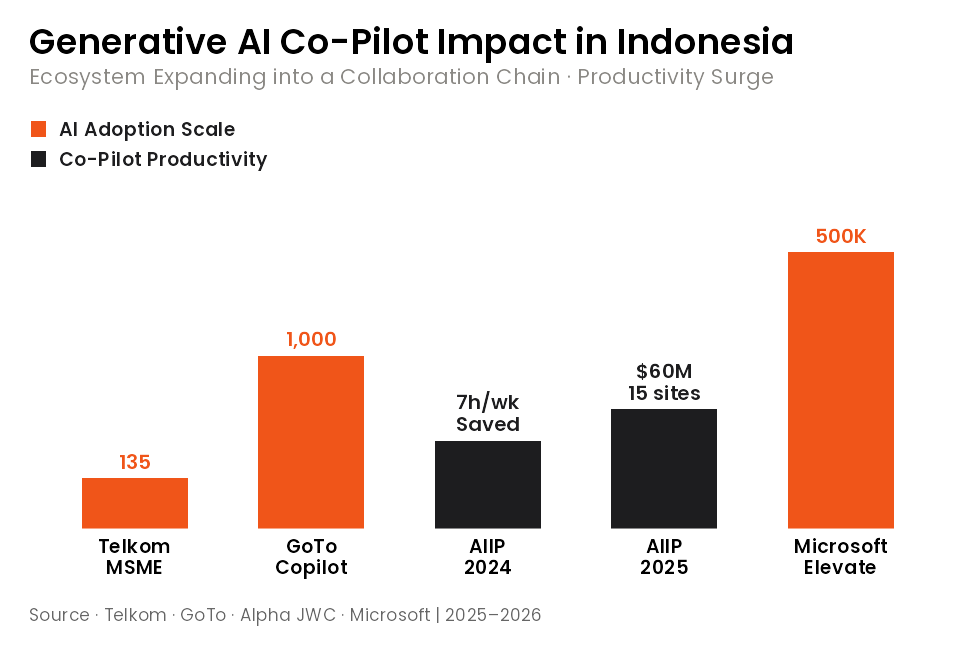
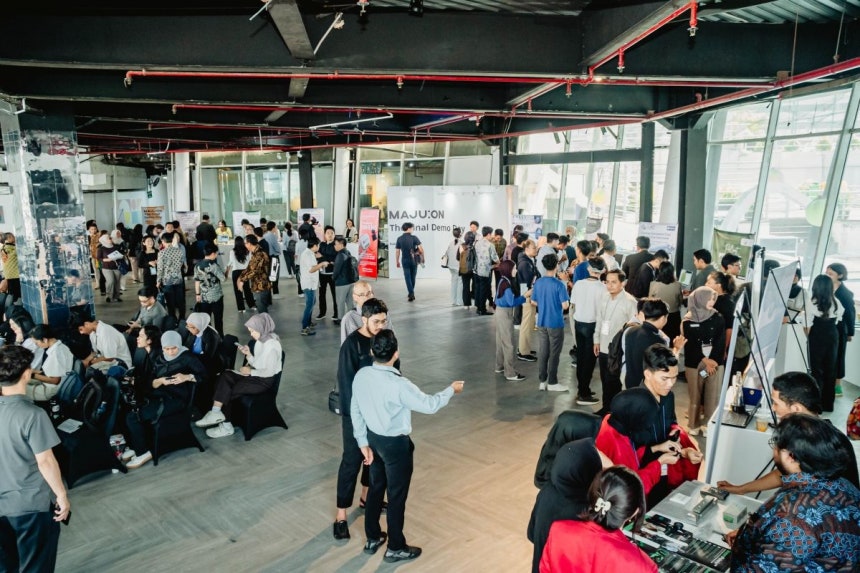
In Indonesia, the copilot is not only a productivity tool. It connects the workplace, accelerators, government strategy, and global big-tech partnerships into one chain.
In the workplace, AI is cutting hours. GoTo Group used an AI copilot to reduce engineers’ working time, and Meeting.AI cut the time spent on meeting notes.
The programs add another layer. AIIP develops promising AI startups and links them to corporate partners, which improves their chances of follow-on growth. Government and global-company collaboration adds to this. Indonesia pursues AI-startup development and specialist training as national strategy, widening its execution base through partnerships with Google Cloud and Microsoft.
What stands out in Indonesia is that these players do not move separately; they connect into one chain.
Indonesia Point
■ Indonesia’s AI copilot links corporate efficiency with national strategy.
■ Companies cut working hours; programs drive startups’ follow-on growth.
■ Government and big-tech collaboration advances AI startups and talent at once.
■ The point is that on-site efficiency, incubation, government strategy, and big-tech partnership run as one chain.
5. India Signal
India: building the base
for wider access
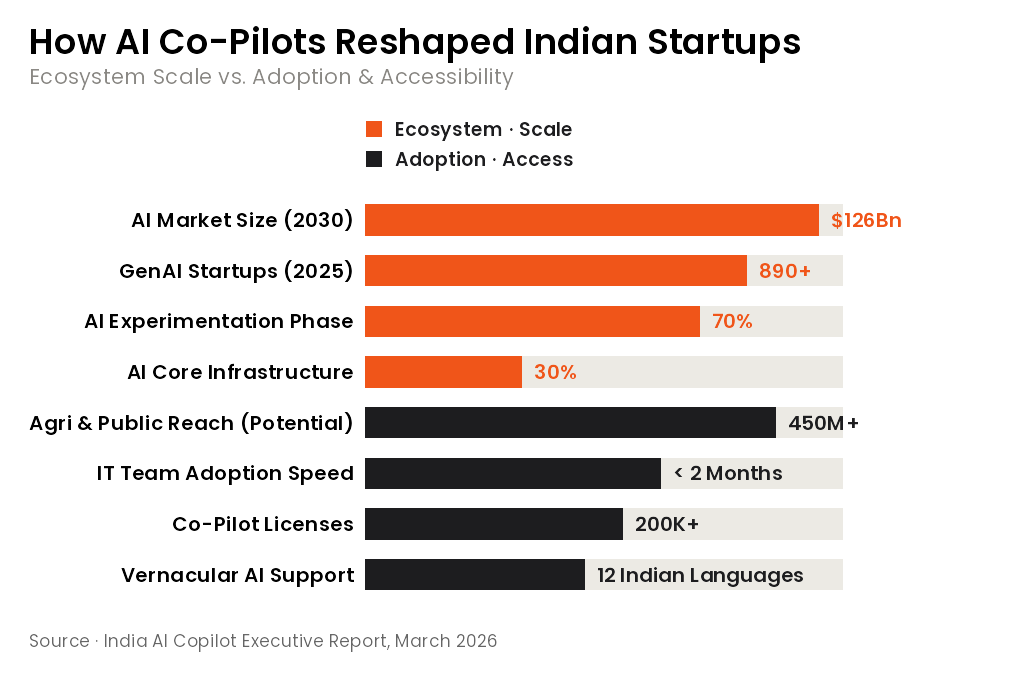
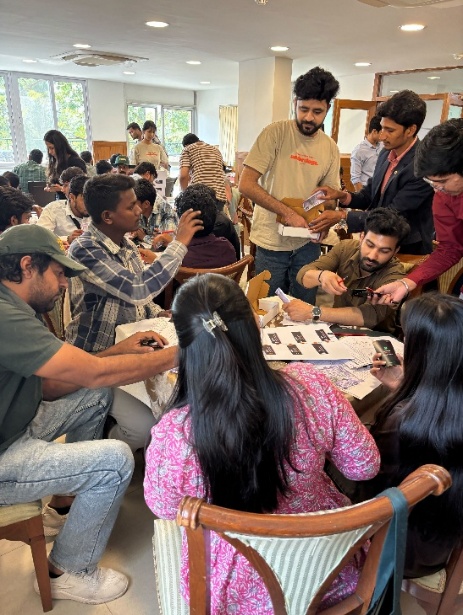
India does not confine the AI copilot to a single company or program. By connecting AI to public platforms, local-language services, and the farming and labor frontlines, it is building the potential to extend AI access to far more people.
Copilot adoption is growing quickly in the workplace. Alongside that, public platforms such as eShram and NCS serve informal workers, while Sarvam AI and KissanAI build local-language services for farmers and everyday use.
What stands out in India is access rather than capability. The direction is to move AI from a specialists’ tool toward something more founders, and everyday users, can pick up.
India Point
■ In India, the copilot is being connected to public platforms and everyday services.
■ The emphasis is on access more people can actually use.
■ Local-language support opens AI to founders, workers, and farmers.
■ The direction is from a few specialists toward a much wider base of users.
6. From Brief to Action
What matters is not who knows AI,
but how much gets done with it
The four cases point in the same direction.
The AI copilot is no longer only a work aid. In practice it is starting to work like a co-founder — helping rework the business model and raising how much a founder can get done.
Korea shows AI keeping small teams effective and helping founders through the low points. Japan shows it easing the perfectionism bottleneck and getting founders in front of customers sooner. Indonesia and India show what shared infrastructure between government and big tech can open up, past the limits of language and capital.
In the end, what separates founders will not be who knows AI best, but who puts the copilot at the points where execution would otherwise stall.
The measure of venture-building is shifting from hours logged or lectures attended to how much actually gets done on the ground. That is where an AI copilot earns its place alongside Act-preneurs.
✓ This Month’s Action Guide
Make Your First Content with AI
This month, we introduce Action AI.
Action AI is a program where, with no coding experience, you shape an idea with AI
and build an AI product you can actually share.
The step that matters is not learning AI,
but deciding what to build with it.
✓ Action Lab
This brief’s questions lead into real execution projects.
Turn the signals of change into concrete action through Action Seminars, webinars, and Underdogs’ field programs.
▸ Localize Gunsan: The Archive and Beyond
✓ Next Brief: The Solopreneur Operating System (when one person works like an organization)
The next Action Brief : ASIA turns to solopreneurs one person running planning, production, sales, and operations with AI and platforms.
Before hiring a team, we will look at how far one person’s execution system can carry a business.
Beyond the startup, into the organization and everyday life.
Beyond Korea, into Asia.
Each month, we read Asia’s transformations through a doer’s lens and,
grounded in the Underdogs Data Center’s research and field data,
set the benchmark for your next move.
Action Brief : ASIA
Execution Intelligence for Asia’s Act-preneurs